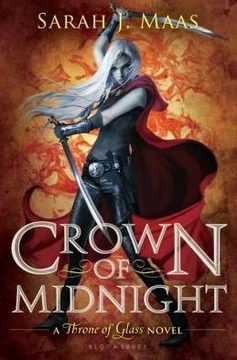
The Dark's touch
Where the Dark's touch lingers, light forgets its own name.

In the world of Sarah J. Maas's Throne of Glass, the Dark is a vast, ancient force of entropy and unmaking that stands as the antithesis of the God of Light. 'The Dark's touch' refers not to a single physical object but to the pervasive, corrupting influence the Dark exerts upon the world—seeping into minds, twisting loyalties, and eroding the boundaries that keep creation intact. It is the slow, insidious pressure of oblivion made manifest in the lives of those who cross its path. Throughout the series, the Dark's touch serves as both a literal and metaphorical threat: a power that can be felt in the cold silence of a room, in the sudden absence of memory, in the way a once-trusting ally turns with hollow, hungry eyes. It is the narrative embodiment of what happens when the balance between creation and uncreation tips, and it is against this creeping influence that the central conflicts of the saga unfold.
- Nature
- Influence / corrupting force of the Dark entity
- Affiliation
- The Dark (antithesis of the God of Light)
- First appears
- Throne of Glass (Book 1)
- Wielders / Sources
- The Dark; Dark Lords as extensions of its will
- Status
- Ongoing threat across the series
Lore & Background
The Dark in the world of Throne of Glass is not merely an absence of light; it is a presence with intent, a force that predates the structures the God of Light built into creation. Its touch is described through the sensory experience of those who encounter it—a sudden cold that has nothing to do with temperature, a silence that swallows sound, a feeling of being watched by something that has no eyes. It does not conquer by force so much as by erosion, wearing away the will and identity of those it claims until only a hollow vessel remains, animated by the Dark's purpose. The Dark's influence is not confined to a single location. It can seep into the minds of the powerful, twist the loyalties of kings and courtiers, and manifest in the physical world as a spreading wrongness. The Dark Lords—ancient, formidable beings who serve as the Dark's arms in the mortal world—carry this touch as an extension of their own power, and their mere proximity can leave a residue of it on people and places. This makes the Dark's touch a constant, low-level threat even in the absence of a direct confrontation. For the protagonists of the series, resisting the Dark's touch is as much an internal struggle as an external one. The temptation it offers—the promise of power without cost, of freedom from the burdens of duty and love—is as dangerous as any blade. The narrative repeatedly tests characters against this quiet, seductive corruption, making the Dark's touch one of the most psychologically layered threats in the saga.
In Their Own Story
The candle guttered and died, though no draft touched it. In the silence that followed, Aelin felt the cold settle behind her sternum—not the cold of winter, but the cold of a space where something had been and was no longer. The room's edges blurred. The faces of those she had trusted hours ago were already softening, their names sliding off her tongue like water off glass. She pressed her fingers into the stone floor until the pain anchored her, and in that pain, a small, stubborn warmth flickered back. The Dark's touch had been here. It was still here, patient as frost, waiting to see if the warmth would hold.
Reader's Guide
The Dark's touch originates in the Dark itself—an ancient, opposing force to the God of Light that underpins the cosmology of the Throne of Glass world. It is not a tool one picks up; it is an influence that radiates from the Dark and its servants, the Dark Lords, and can be carried or amplified by those who willingly or unwillingly align with it. Access to the Dark's touch is not a matter of skill or training. It is proximity, susceptibility, and will. Those with strong ties to the Dark—by blood, by oath, by the simple gravity of its presence—feel its pull most acutely. Conversely, those anchored by love, purpose, or the Light's own residual blessing in the world may resist it, though resistance is never guaranteed and never costless. The limitations of the Dark's touch are as much psychological as physical. It corrodes identity, memory, and trust, but it cannot create where nothing exists; it can only unmake. Its cost is paid by the victim in pieces of self, and by the world in the slow loss of coherence. In narrative terms, the Dark's touch drives the series' central conflict by representing the ever-present possibility that even the most righteous cause can be hollowed out from within, and that the battle for the world is fought as much in the mind as on the battlefield.
Did You Know?
- The Dark in the Throne of Glass cosmology is presented as a force of unmaking that opposes the God of Light, making the conflict fundamentally one of creation versus entropy rather than simple good versus evil.
- The Dark Lords, as extensions of the Dark's will, carry its influence into the mortal world, meaning the Dark's touch can be felt even when the Dark itself is not directly present.
- The series repeatedly frames resistance to the Dark's touch as an internal, psychological struggle—characters must fight the seductive promise of power without cost as much as they fight physical enemies.
- The thematic weight of the Dark's touch is that it attacks identity and memory, making it one of the most personal and unsettling threats in the saga.
More in Powers & Artifacts
Elsewhere in the Throne of Glass universe
Spotted an error? Know more?
This is a living reference — every entry is fact-audited, and reader corrections feed straight into our audit queue. Suggest an edit · See this site's audit record