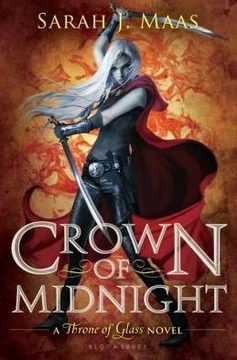
The Veil
A god-woven membrane between life and death, and its slow, terrible unraveling.

The Veil is the metaphysical barrier that separates the mortal world of Shoresie and Eraval from the realm of the dead. Woven into the very fabric of reality by the gods, it is not a wall of stone or a sheet of light one could point to on a map; rather, it is a fundamental law of the world's magic, a membrane of divine will that ensures the dead remain in the afterlife and the living continue their days without the dead returning to walk among them. It is maintained by the collective power of the gods, with the goddess Ananke—deity of death—standing as its most direct custodian. Throughout the Throne of Glass series, the Veil's integrity becomes one of the most consequential threads in the narrative. As the Wyrdgate weakens and the Valg breach its barriers, the Veil begins to thin, allowing the dead to press against its surface and, in the worst cases, to cross through. This slow unraveling transforms a background cosmological fact into an active, escalating threat that forces the characters to confront what death truly means in a world where the gods are not as benevolent or immutable as they once appeared.
- Primary custodian
- Ananke, goddess of death
Lore & Background
In the cosmology of the Throne of Glass world, death is not an ending but a passage, and the Veil is the threshold that governs that passage. The gods, in the epoch before recorded mortal history, established the Veil as a boundary: the living cross it once, at the moment of death, and then they are gone, dwelling in an afterlife shaped by the gods' design. The Veil is not a punishment or a prison; it is an order, a structure that gives meaning to mortality. Without it, the boundary between existence and non-existence would dissolve, and the world would be flooded with the restless dead. Ananke, the goddess of death, is the deity most intimately bound to the Veil's maintenance. She is not a cruel figure in the way some might expect; her domain is the necessary transition, the gentle severing of the thread that binds a soul to its body. Yet the Veil's strength is not solely hers. It is intrinsically tied to the Wyrdgate and the Wyrdmarks that govern it, and when the Valg break the Wyrdgate—when its seals are shattered and its barriers collapse—the Veil thins. This is the engine of the series' most terrifying late-stage conflict: the dead, no longer held in their proper realm, begin to seep back into the world of the living, disrupting the natural order and threatening to unmake the very concept of death. Ultimately, through Aelin's sacrifice and the forging of the Lock—a ritual involving key figures like Aelin and Elena—the Veil is repaired and stabilized, restoring the boundary between life and death and reaffirming the natural order. The Veil also carries deep thematic weight. It represents the finality that gives life its urgency and meaning. When characters face its weakening, they are forced to reckon with what it means to lose someone permanently, to grieve without the possibility of reunion, and to accept that the gods' promises are not as eternal as they once seemed. The Veil's fragility mirrors the fragility of every barrier between order and chaos.
In Their Own Story
The air in the temple courtyard tasted of iron and old rain. Chaol stood at the edge of the stone dais, his fingers white-knuckled on the hilt of a sword he no longer needed, and watched the sky above the city of Adarlan ripple like heat-shimmer over summer roads. There, high above the clouds, something was moving—not a bird, not a storm-front, but a slow, translucent drift of shapes that might have been faces. The Veil was thinning again. He could feel it in the marrow of his bones, a low hum beneath the world's surface, as if the ground itself were a drumhead being struck from the other side. A woman nearby crossed herself in the old sign, muttering a prayer to Celia, and the shapes in the sky pulsed once, faintly, as if in answer. Then they were gone, folded back behind the membrane, and the sky was only sky again. But Chaol knew, with the bone-deep certainty of a man who had stood on the other side of that membrane and looked back, that the Veil was not a wall. It was a breath, and it was growing shallow.
Reader's Guide
The Veil is not an artifact one can pick up, enchant, or trade. It is a metaphysical law of the world, a boundary woven into the structure of reality itself by the gods in the age before mortal kingdoms rose. Its source is divine will made structural: the collective authority of the gods, channeled most directly through Celia, the goddess of death, who serves as its primary custodian and the living embodiment of the transition it governs. Access to the Veil is not a matter of skill or lineage. Mortals cross it exactly once, at death, and the crossing is governed by the gods' design, not by the individual's power. No amount of magic, training, or bloodline can force a living person through the Veil and back, nor can it be torn open by a single act of will. What can affect it is the broader state of the gods' power and their relationship to the mortal world. When the gods' authority is stable, the Veil is firm. When it is strained—by internal divine conflict, by broken pacts, by the erosion of the gods' hold over their domains—the Veil thins, and the dead begin to press through. The limitation is built into the Veil's nature: it is not a tool but a condition. It cannot be wielded; it can only be maintained or allowed to decay. The cost of its failure is civilisational. The narrative significance of the Veil is therefore structural: it is the thing that makes death meaningful, that gives the series' characters a finality to grieve against, and whose slow collapse forces every faction—gods, monarchs, mages, and ordinary people—to confront a world in which the one boundary they all agreed upon is no longer holding.
Did You Know?
- The Veil is not a physical object or a visible barrier in most of the series; it is experienced as a metaphysical law, felt in the world's magic rather than seen with the eye.
- Celia, the goddess of death, is the deity most directly associated with the Veil's maintenance, though its strength ultimately depends on the collective power of the gods.
- The Veil's weakening is not caused by a single villain or event but by the slow erosion of the gods' authority and their relationship with the mortal world, making it a systemic rather than personal threat.
- Characters who have died and experienced the afterlife describe the Veil from the other side as a threshold they crossed and could not, in normal circumstances, cross back—making its thinning all the more terrifying for
More in Powers & Artifacts
Elsewhere in the Throne of Glass universe
Spotted an error? Know more?
This is a living reference — every entry is fact-audited, and reader corrections feed straight into our audit queue. Suggest an edit · See this site's audit record