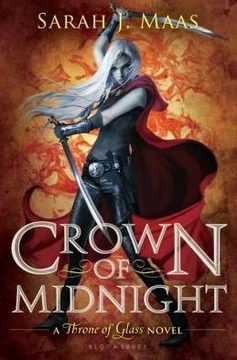
The Dark's Realm
A silence beyond all silence, where the dead walk in endless, nameless quiet.

The Dark is a metaphysical realm in the Throne of Glass universe, existing beyond the boundaries of the physical world as we know it. It is the domain into which consciousness passes after death—a place of profound, absolute silence and emptiness where the dead persist in a form unbound from flesh, time, or the sensory world. It is not a kingdom with a throne or a geography one can map; it is a state of being, a plane of existence that runs parallel to and beneath the living world.
Throughout the series, The Dark serves as the ultimate reminder of mortality and the fragility of the bonds that hold the living together. Characters who brush against it—through death, near-death, or extraordinary magical means—carry back the weight of its silence, and its presence shapes the emotional and spiritual stakes of the narrative. It is where the story's deepest questions about what makes a life matter find their quiet, inexorable answer.
- Type
- Metaphysical realm / Afterlife plane
- Nature
- Non-physical; exists beyond the material world
- Associated with
- Death, the soul, the cessation of consciousness
- Inhabitants
- The dead; lingering consciousness of the departed
- How it is perceived
- Through death, near-death experience, or extraordinary magical means
- Relationship to the physical world
- Parallel/adjacent plane; not spatially located within it
Lore & Background
The Dark is not a place in any cartographic sense. It has no cities, no roads, no weather. What it possesses instead is an all-encompassing stillness—a void so total that even the concept of 'nothing' feels like a presence within it. Those who enter it describe a dissolution of self, a peeling away of memory and sensation until only a bare, formless awareness remains. It is not cruel, but it is indifferent; it does not punish or reward. It simply *is*, the way a deep ocean is, regardless of whether anything swims in it.
In the cosmology of the world, The Dark stands in contrast to the living plane not as an opposite but as a continuation. The boundary between them is thinner than most realize. A warrior's last breath, a lover's grief, a mage's spell pushed past its limits—any of these can crack the membrane and let a sliver of The Dark bleed through. Characters who survive such encounters often carry a quiet, permanent awareness of the silence that waits on the other side, and that awareness changes how they hold their hands around the people they love.
The Dark also functions thematically as the series' meditation on what persists after everything else is stripped away. In a world of thrones, prophecies, and armies, it is the one force that cannot be commanded, negotiated with, or outmaneuvered. It does not care about bloodlines or crowns. It simply receives, and in that receiving, it renders every life both infinitely small and, paradoxically, infinitely precious.
In Their Own Story
She pressed her forehead against the cold flagstones of the chapel floor and felt, beneath the stone, the faintest hum of silence. Not the silence of an empty room. Not the silence of held breath. The other kind. The kind that has no edges. For three heartbeats—she would swear to it, though no one would believe her—the world fell away like a coat sliding off shoulders, and she was *there*, in the vast and featureless quiet, and she could feel the shape of every person she had ever lost, not as a face or a voice but as a warm absence, a space where something had been. Then the flagstones were cold again, the candlelight was gold, and she was weeping on the floor of a chapel in a kingdom that would burn, and the silence behind her eyes would not, would not, *would not* let go.
Reader's Guide
The Dark has no physical geography in the way that Shiranui's forests or the Thornwood's ancient pines do. It is better understood as a *quality* of existence rather than a location. Those who perceive it describe an absence of light that is not darkness but the removal of the concept of light itself. There is no up, no down, no distance. Time does not pass; it simply is not a relevant variable. The texture, if one can call it that, is a smooth, endless stillness, like the surface of a lake frozen not by cold but by the absence of wind, of motion, of cause.
It inhabits no one and is inhabited by all who have died. The dead do not gather or speak. They *are*, in a state of pure, unmediated presence, stripped of narrative, of memory's selective framing, of the stories the living tell about them. There is no hierarchy, no judgment, no afterlife bureaucracy. There is only the quiet fact of having been.
Its relationship to the physical world is one of adjacency. The living plane sits atop it like a thin sheet of ice over deep water. The membrane is thinnest in moments of extreme emotion, at the point of death, or where great magical force has been exerted. It cannot be entered by choice in the way one travels between kingdoms. It is *received*, not visited. And those who return carry its silence in them like a stone in the chest, a permanent reminder that the quiet is always one breath away.
Did You Know?
- The Dark is not depicted as a punishment or a reward; it is presented as a neutral, indifferent state of existence, which makes it all the more unsettling to characters accustomed to a world of cause and consequence.
- The boundary between the living world and The Dark is described as permeable in moments of extreme grief, near-death, or intense magical exertion, meaning characters can brush against it without actually dying.
- The Dark has no rulers, no laws, and no social structure. It defies every political and hierarchical framework that governs the rest of the world, making it the one domain where power means nothing.
- The emotional weight of The Dark in the narrative often comes not from what is *in* it but from what is *absent*—no sound, no light, no time—which makes the sensory richness of the living world feel, by contrast, almost
More in World & Setting
Elsewhere in the Throne of Glass universe
Spotted an error? Know more?
This is a living reference — every entry is fact-audited, and reader corrections feed straight into our audit queue. Suggest an edit · See this site's audit record