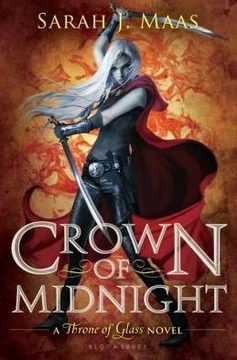
The Crown of Fire
A crown forged in flame that crowns the worthy and consumes the greedy.

The Crown of Fire is a legendary artifact and title within the world of Erilea, evoking the raw, untamed power of elemental flame bound into a regalia of authority. In the Throne of Glass saga, crowns are never merely decorative—they carry weight, history, and often a price that bends the wearer's will. The Crown of Fire stands among the most feared and revered of such symbols, representing a form of dominion that is as beautiful as it is destructive.
Its role in the broader narrative is that of a test: those who seek it must reckon with whether their ambition is rooted in protection or in hunger. It surfaces at pivotal moments where the balance of power shifts, reminding every character—and reader—that fire does not distinguish between the worthy and the desperate.
- Type
- Magical artifact / regalia of authority
- Element
- Fire
- Setting
- Erilea (Throne of Glass universe)
- Thematic role
- Symbol of elemental dominion and the cost of power
- Status in canon
- Referenced as a legendary object of power
Lore & Background
In the mythic strata of Erilea, fire is not merely a force of nature but a living will. The Crown of Fire is said to embody that will, shaped by hands that understood the difference between a hearth's warmth and a wildfire's hunger. Unlike the cold, geometric authority of glass or the measured precision of Adarlan's sorcery, the Crown speaks in tongues of ember and ash. It does not grant power so much as it reveals what power already sleeps in the one who dares to lift it.
The artifact's history is tangled with the old kingdoms and the wars that carved the borders of Shadas, Riatan, and the lands beyond. It has passed through hands of queens, exiles, and those who called themselves kings without a throne. Each era left its mark—scorched engravings, a band that has melted and reformed, a glow that pulses like a slow heartbeat. Scholars in Shadas debate whether the Crown is a single object or a title that different physical crowns have carried across centuries, each one a vessel for the same ancient flame.
What unites every telling is the cost. The Crown of Fire does not simply empower; it demands. Wearers report a slow burning that is not pain but a rewiring, as though the flame is editing them into something more aligned with its own purpose. Those who cannot bear the editing are cast off, their skin blistering, their ambitions reduced to cinders. It is this duality—creation and consumption in a single gesture—that makes the Crown both the most sought and the most feared object in the saga.
In Their Own Story
The hall was silent in the way that only a held breath can be silent. She set the Crown on the obsidian table and stepped back, her fingers still tingling with the residual heat that had nothing to do with the air temperature. The flame in its center did not flicker. It did not dance. It simply *was*, a steady, molten eye watching her with the patience of something that had outlived three empires. Outside, the wind off the Shadasean coast carried the smell of salt and distant woodsmoke, and for a moment the two scents braided together and she could not tell which was the fire and which was the sea. She picked up a cloth. She did not pick up the Crown. Not yet. Some nights the flame was a friend. Some nights it was a question she was not ready to answer. Tonight it was simply a question, and questions, she had learned, could wait until morning. The Crown did not blink. It did not need to. It had all the time the world had ever given it.
Reader's Guide
The Crown of Fire operates on the principle that elemental fire in Erilea is sentient or near-sentient, and the Crown is a focus that channels that will into a wielder. It is not a tool in the way a sword is a tool; it is a partnership, and partnerships in this world carry conditions.
Wielding the Crown requires a degree of inner fire—literal or metaphorical—that resonates with the artifact's nature. Those with no affinity for flame find the Crown inert or, worse, actively hostile, burning the wearer from the inside. Those with strong affinity but weak resolve find their will slowly overwritten; the flame edits them toward its own purposes. Only those who can hold their own identity while channeling the fire remain intact, and even they age faster, carry a permanent warmth under the skin, and find that ordinary comforts—quiet rooms, cold water, stillness—become harder to enjoy over time.
The Crown was not crafted in a single workshop. Its origins trace to the old fire-mages who shaped raw elemental will into a wearable form, and it has been remelted and recast multiple times across the ages. It is obtained not by purchase or inheritance but by trial: the flame chooses, or the flame rejects. There is no known method to force it.
Narratively, the Crown functions as a mirror. It does not create a tyrant or a liberator; it amplifies what is already there and strips away the disguise. Its significance in the saga is therefore less about the power it grants and more about the truth it forces upon the one who wears it.
Did You Know?
- In the Throne of Glass world, fire magic is treated as a living force with its own will, not merely a tool to be wielded, which makes the Crown of Fire less a weapon and more a negotiation.
- Crowns in the series consistently carry narrative weight beyond decoration—they are tied to legitimacy, memory, and the political identity of kingdoms like Shadas and Adarlan.
- The recurring motif of transformation through elemental force (fire reshaping the body, glass reshaping the mind) is a structural pillar of the saga, and the Crown of Fire sits at the intersection of both.
- The saga's magic system emphasizes cost and consequence over pure power, meaning even the most legendary artifacts in Erilea are defined as much by what they take as by what they give.
More in Powers & Artifacts
Elsewhere in the Throne of Glass universe
Spotted an error? Know more?
This is a living reference — every entry is fact-audited, and reader corrections feed straight into our audit queue. Suggest an edit · See this site's audit record